

Pros
- Everything* in there has been checked for alignment with the course Learning Objectives (LOs) and Science Practices (SPs).
- Everything* in there has been checked for accuracy.
- Lots of Question Bank Items, including released actual questions and new questions recently written
- There is an official solution/scoring guideline for all question items.
- Flexibility in usage, due now or later, available in a window of time or always, paper or online (for Question Bank items)
- Lots of Formative Assessment – i.e. Topic Questions and Personal Progress Checks (PPCs) (see this blog post for definitions), PPCs give you data about student preparedness
- Search by LO, SP, Unit, question type, stimulus type (graph, diagram, etc.), security, exam alignment, etc.
- AP Daily Videos can teach your students (or YOU!) essential skills – especially seems useful when you or students are struggling with a derivation in AP Physics
- Automated grading of Multiple Choice (MCQs)
- Scoring Guideline and online scoring of Free Response (FRQs) works pretty well
- Students can grade their own FRQs using the same rubric teachers use
- Can send students feedback notes (encouragement!) when grading
- AP Daily Videos provide scaffolding for struggling students, supports inclusion of ALL students in your classroom
Cons
- the asterisk (*) above means some mistakes were made in alignment and in accuracy, and the College Board has been excruciatingly slow in correcting them (it’s been three years, and no changes), one notable one that comes up over and over again is the Unit 1 MCQ PPC for C Electricity, it has a question that goes beyond the boundaries, AND has an incorrect solution
- Printing Question Bank Items often involves a lot of formatting issues and there is no way to change formatting
- Navigation in the site is sometimes confusing, although that usually improves with the frequent updates
- Personal Progress Checks and all Videos can only be assigned online through AP Classroom
- Personal Progress Check MCQ sets can’t be broken into shorter chunks and many (most?) are too long for my students
- Some PPC items seem too convoluted in their setup to be aligned with the AP Exam (they may still be useful)
- Students must log in to see feedback and scoring, doesn’t appear to be a notification system for them (at least I think not)
- Videos track “watched” completion, but who knows if they actually watched the video
- AP Classroom has, at times, been excruciatingly slow (updates may have improved this issue)
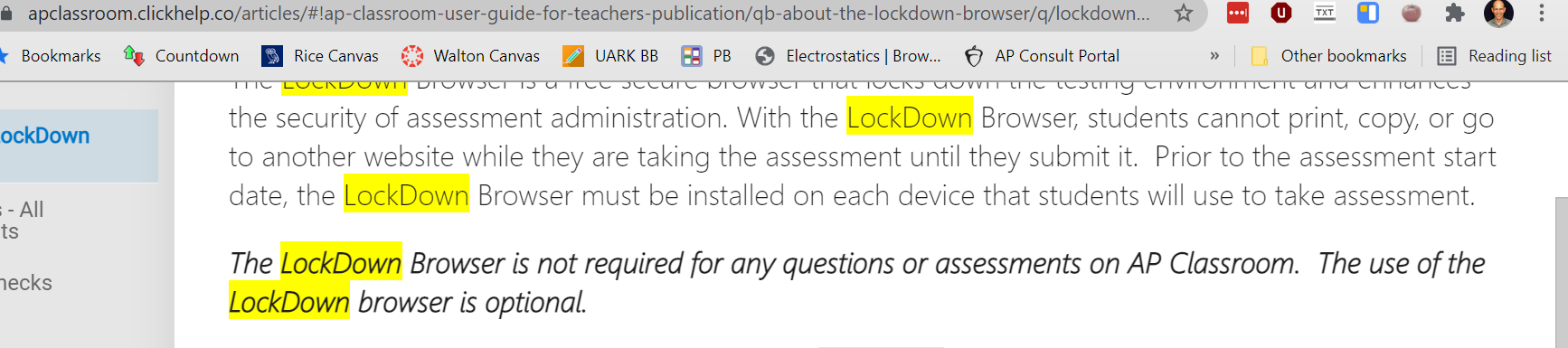
- The Lockdown browser had a lot of problems at first and would crash, causing students to lose their work. This has been fixed to automatically submit their work when it crashes. I have not used it much since the fixes and can’t attest to the improvement.
Best Practices in AP Classroom
This will need to be added to, as I collect more
- Make all AP Daily Videos available at the start of the year, watch a few in class at the beginning of the year to show them how great they are, stop them at various points to discuss/answer questions. Make sure students are reminded/encouraged to watch them throughout the year.
- Make PPCs available, sometimes do them in class, so you can answer questions/talk about the tricky questions with everybody at the same time. This also encourages completion. Con is it takes a lot of class time.
- Use AP Daily to teach YOURSELF tricky things and then show that tricky derivation to students yourself, in class.
- Use PPCs for yourself BEFORE teaching a unit, to get an idea of the content, rigor level, and types of things the CB could ask (but bear in mind alignment and accuracy is not perfect for all PPCs).
- Use AP Faculty Lectures (the longer videos) for review. Some fellow teachers have shared questions to go with those.
- Assign students Topic Questions in class for a warm up/bell ringer or Exit Ticket.
- Use the Question bank to construct a quiz, test, or homework assignment (best to give students AP level work throughout the year, while scaffolding/supporting as much as possible)
- Give a Mock Exam online using the Practice Exams (but be aware of restrictions)






 marcreif
 fysicsfool