Science teachers want students to think like scientists, write like scientists, and investigate like scientists. Writing has special prominence in AP Physics 1 and 2.
In order to learn to write like a scientist, students have to practice writing, get feedback, respond to the feedback, and revise their writing. Using an LMS and a few simple guiding principles can make that writing-feedback-revising cycle work in the classroom.
The Covid-19 Pandemic has caused a lot of changes in the lives of teenagers and their teachers this spring. School for us closed on March 12, and we went to online instruction through Google Classroom and Zoom meetings. The College Board elected to make all AP Exams online, 45 minute exams. The AP Physics Exams this year consisted of only two free-response questions. The questions could be answered completely by typing. None of the questions required drawings, diagrams, graphing, or derivations. In previous years, all of these tasks were very important parts of the AP exams. I spent a lot of time last year training my students to do them. Now, they were going to write about the tasks, and they were free to use notes, textbooks, or Google to help them answer the questions.
So, I changed the way I wrote my assignments. I turned drawing free-body diagrams into “describe the forces” and “calculate” into “does this equation make sense”? And I changed the way I assessed assignments. I instituted a new grading scheme. I commented on every part of every assignment. Relatively flawless work earned a 100%. Students whose work had major flaws were allowed to revise and resubmit multiple times. If a student didn’t get the work up to my standards, they earned a 60%.
This system worked very well. Rather than checking for right answers, I was looking for correct understanding. Instead of getting a grade, students were getting feedback and felt compelled to respond to the feedback. It sometimes took a couple of tries for the student to get it right, but they did improve.
So, I came up with some guidelines that worked for this grading scheme:
- Make short writing assignments, 10 questions or fewer. One page is ideal (no scrolling).
- Assignments involve explaining a physics idea or ideas in words.
- Make all the assignments in an easy to grade format in Google docs.
- Give directions to the students for their response “Type your coherent, paragraph-length response in this box”.
- Use your judgment as to whether the answer is good enough. Make a rubric or scoring guideline before grading, to make sure that you are consistently grading.
- If a student misstates, misinterprets, or doesn’t use one of the ideas in a correct response, they must correct their answer
- Give students low grades (60%) and demand corrections before improving the grade.
- Write comments on each response to show them how to correct.
- If the corrections are not correct, write a more directed comment and ask them to redo. If there are lots of mistakes on a longer document, pick only the most important questions and only demand that they redo those.
- Grade fast so they can work on their modified response right away.
Here is an example of an assignment I wrote. Students learned this topic virtually. Below is the stem and the stimulus for part (a).
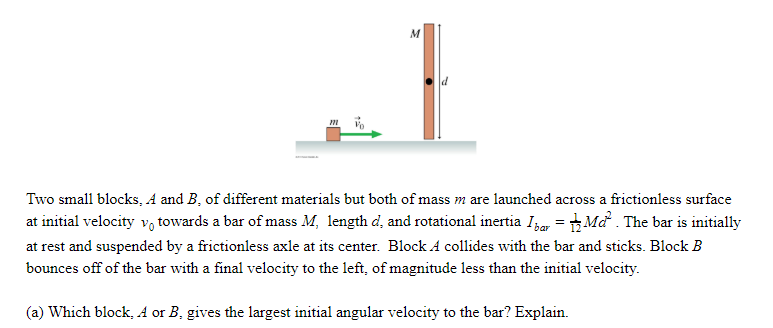
And here is the stimulus for part (b).

Below is a student’s modified answer to part (a) with my original comment. The blue check mark means that the comment was marked as resolved. The first attempt earned a grade of 60:
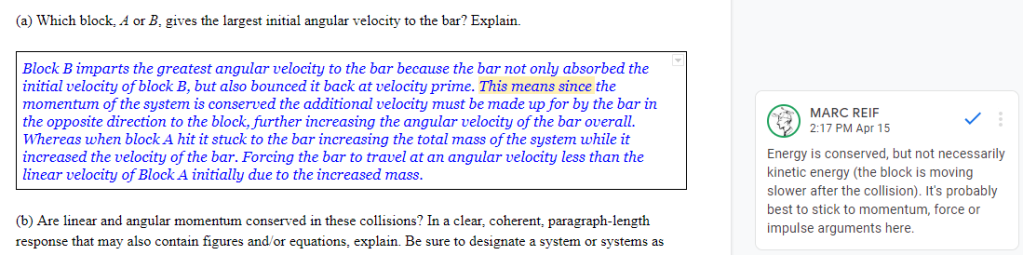
And below is the same students modified answer to part (b) with my original comment:

And here are the general comments between student and teacher.
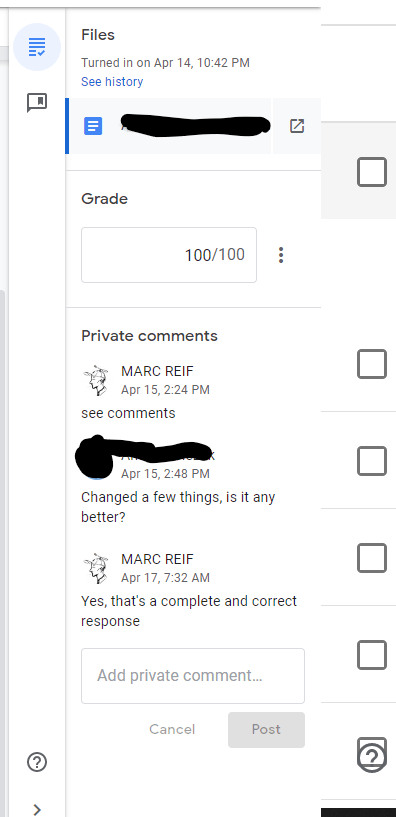
Yes, the Google Classroom Learning Management System (LMS) makes this easier, but it could be done without it, using Microsoft Word’s reviewing features, for example.
The assignments were short, students knew they had the opportunity to revise and the feedback was (relatively) swift. A number of them seemed to improve in their writing as we went through the process of reviewing for the AP1 exam.

 marcreif
 fysicsfool
How many students are you giving feedback for on each assignment?
Last spring during virtual school about 50. This fall I will have 88 AP students. If the assignment only has a couple questions, I can do 25 students in less than an hour. That is reading their response, and replying on the substance of the response. It depends on having a good rubric or exemplary answer before you start grading, and using the comment bank in Google Classroom. With the comment bank I don’t have to actually type so many of the comments. Last spring these assignments were the only grade in the class during virtual. I will have to reduce the number of graded assignments to keep this going this fall. Considering doing lab reports and quizzes on Google Classroom the same way. Don’t yet have a solution for tests. Ideas?
My solution for tests is probably going to be watching them take it live. That’s what the Rutgers Math department is doing, and AP is supposed to be a college class, right?
I thought about that. I want to make a part of tests a deeper, reflective writing assignment so cheating is not an issue. Sounds good but may be difficult to do.
Sounds like useful information, but difficult to grade as a summative assessment of content understanding.